What the industry can measure
- Higher visual fidelity
- More elaborate physics
- More reactive environments
- More convincing virtual consequences
- More things to consume
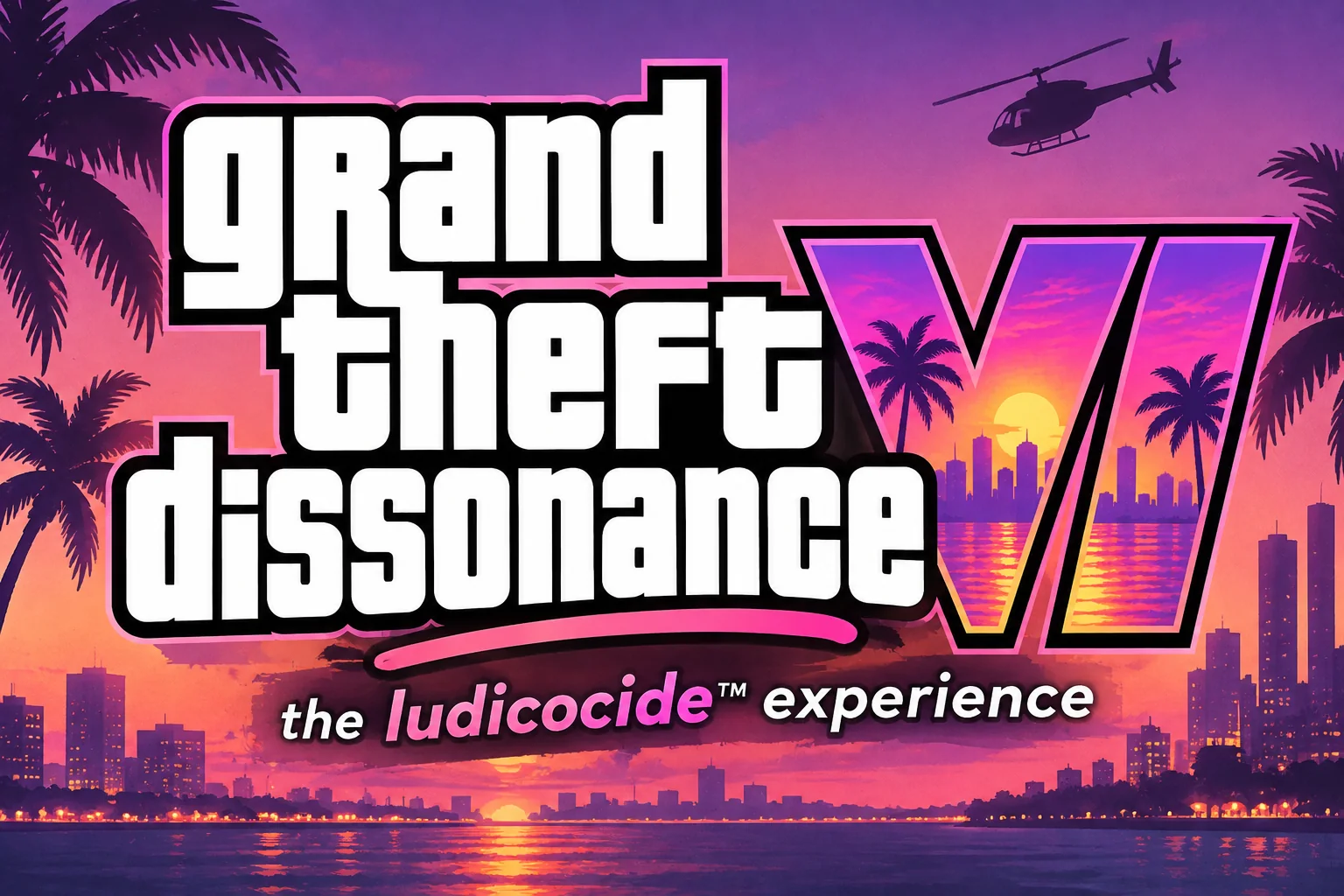
Three years of genocide on one screen. The next great simulation of killing on the other. And we're supposed to be excited?
GTA used to offer absurdity, exaggeration, satire and consequence-free mayhem. But when violence looks more and more like the footage already on our screens, what exactly are we escaping into?
The promise is technical: more convincing bodies, physics, reactions and consequences. The question is cultural: why should more realistic simulated killing count as progress when real mass killing is already a daily media spectacle?
This is a critique of the marketing of realism and the cultural moment, not a review of game mechanics that have been independently tested.
Slide the industry's favorite dial. Watch the marketing language improve. Notice which question remains unanswered.
Satirical slider. Percentages are invented marketing rhetoric, not game statistics.
From the glossy promise of virtual violence to the news footage of actual devastation. The wall is the argument, frame by frame.
Tap or click to enlarge. Illustrative editorial images, not documentary photographs or screenshots of GTA VI. No person shown is a real person.
noun · ludic (play) + -cide (killing)
The transformation of simulated killing into increasingly realistic entertainment, at the very moment real mass killing has become an everyday media spectacle.
noun · cultural exhaustion
The loss of appetite for increasingly realistic simulated violence when images of actual mass killing have saturated everyday life.
noun · media contradiction
The distance between celebrating simulated violence as technical progress and confronting actual violence as human catastrophe.
noun · attention economy
The point at which a culture sells ever more convincing fictional death to an audience already overwhelmed by real death.
Better graphics aren't better gameplay. A bigger map isn't greater freedom. And more convincing killing isn't necessarily progress.
Not because the game can't be technically impressive. Because technical achievement alone is a poor answer to a world already drowning in death.
When real death is everywhere, why is a more realistic simulation of killing the next great entertainment milestone?
Pick a card. Post it, copy it, or download it. Every card links back here.
Hey there. Welcome to Grand Theft Dissonance Six. The ludicocide experience.
It's free. No account, no ads. Every word is on the page, and the line we're on lights up as we go.
And if you know someone who's counting down to G T A Six, the share button is right at the top. Shameless, I know.
Completely shameless.
Okay. Let's play.
From the studio that brought you everything. The future of violence. Looks. Amazing.
Okay, I'm hyped. I'm actually hyped.
Three years of genocide on one screen. The next great simulation of killing on the other. And we're supposed to be excited?
I mean, it's a game. It's always been a game.
It has. G T A used to offer absurdity. Exaggeration, satire, consequence free mayhem. But when the violence looks more and more like the footage already on our screens, what exactly are we escaping into?
More convincing bodies. Physics. Reactions. Consequences.
That's the promise, and it's a technical one. The question is cultural. Why should more realistic simulated killing count as progress, when real mass killing is already a daily media spectacle?
To be fair, nobody here has played the finished thing.
Right. This is about the marketing of realism, and the moment it lands in. It's not a review of mechanics nobody here has tested.
Introducing the innovation report.
Technical realism is not human realism.
Higher visual fidelity. More elaborate physics. More reactive environments. More convincing virtual consequences.
And, at the bottom of the list, the honest one. More things to consume. That's everything the industry can measure.
So what can't it measure?
Whether you get any real agency. Whether the realism deepens the satire, or just sands it off.
Whose suffering becomes the spectacle. What the simulation means to a human being. And the question the marketing never answers. What are we celebrating?
Now. Turn up the realism. Trademark.
There's a slider on the page. It's the industry's favourite dial. Slide it, and watch the marketing language improve.
Turning it up. Sharper pixels, more elaborate physics. Now with seventy percent more immersion.
Maximum realism unlocked.
Human meaning not included.
The percentages are invented. They're marketing rhetoric, not game statistics. Notice which question never moves, wherever you put the dial. More agency for whom?
Thirty six frames. One dissonance.
From the glossy promise of virtual violence, to the news footage of actual devastation. Frame by frame, the wall makes the argument.
It starts with the logo. Palm trees, a sports car, a guy on his couch.
Then the checklist. More realistic mechanics. Physics, injuries, reactions, consequences. Every box ticked.
And then the rubble. A child covered in dust. A mother holding her daughter. A headline. Gaza, third year of genocide.
And the guy on the couch is still looking at the same screen.
When real death is everywhere, why is a more realistic simulation of killing the next great entertainment milestone? Bigger map. Better graphics. More realism. More violence. And one box left. But more agency?
And just to say it out loud. These are illustrations. Not documentary photographs, and not screenshots of the game.
New words, for an old industry.
Ludicocide. A noun. Ludic, meaning play, and cide, meaning killing. The transformation of simulated killing into increasingly realistic entertainment, at the very moment real mass killing has become an everyday media spectacle.
Genocidal realism fatigue. Cultural exhaustion. The loss of appetite for increasingly realistic simulated violence, when images of actual mass killing have saturated everyday life.
Honestly? That's me. That's the feeling I couldn't name.
Grand theft dissonance. A media contradiction. The distance between celebrating simulated violence as technical progress, and confronting actual violence as human catastrophe.
Deathertainment saturation. The attention economy. The point where a culture sells ever more convincing fictional death, to an audience already overwhelmed by real death.
Better graphics aren't better gameplay. A bigger map isn't greater freedom. And more convincing killing isn't necessarily progress.
The stickmen get it.
G T A Six! Bigger world! More realistic mechanics! Hyped!
But more realism means more convincing violence, and consequences.
And we're living through three years of genocide in Gaza, with real death on our screens every day.
So the timing is uncomfortable. Selling a more realistic simulation of violence, while actual mass killing is ongoing.
What the series traditionally offered. Exaggeration and satire. Absurdity and distance. Consequence free mayhem. What it risks now. More graphic realism. More realistic injuries and death. An experience closer to real violence.
So the question isn't just, is G T A Six good?
It's this. When the real world is saturated with images of death, why should a more realistic simulation of killing be the next great entertainment milestone?
And now, the final review.
Meh.
Not because the game can't be technically impressive. Because technical achievement alone is a poor answer, to a world already drowning in death.
When real death is everywhere, why is a more realistic simulation of killing the next great entertainment milestone?
Before you go. One more thing. And yes, it's a plug.
Copy the verdict, or share the page. Both buttons are right there.
And just below, there are ten cards, one tap each. Post one, copy it, or download it.
There's plenty more from Feline Union, all free. Thanks for listening.
G T A Six? Meh.
This was Grand Theft Dissonance Six. A Feline Union publication.